
Tenant-Landlord Dispute Lawyer Fees in Gurugram
Understand Tenant-Landlord Dispute Lawyer Fees in Gurugram, court processes, eviction laws, security refund steps, and practical legal expenses.

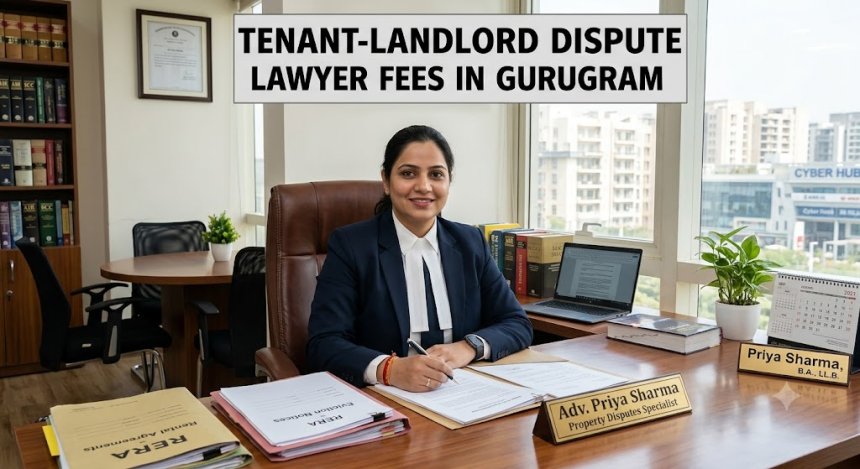
Tenant-Landlord Dispute Lawyer Fees in Gurugram: Practical Guide, Legal Process & Cost Breakdown
Rent-related conflicts are among the fastest-growing civil and quasi-criminal matters across Millennium City. Whether you are an owner trying to reclaim an occupied high-rise apartment in DLF Phase 5 or Golf Course Extension Road, or an IT executive trying to recover an unlawfully withheld security deposit in Cyber City or Sohna Road, understanding the actual expenses involved is critical.
People searching for Tenant-Landlord Dispute Lawyer Fees in Gurugram frequently face stressful situations: an impending illegal eviction, months of accumulated rent arrears, bounced maintenance cheques, or refusal to return hefty security deposits. Navigating the legal system in Gurugram requires practical knowledge of local court procedures, realistic legal fee structures, and the exact steps required under Indian tenancy law before serving a notice or filing a petition.
Understanding the Dispute Landscape in Gurugram
Gurugram's rental market is unique due to high property valuations, massive corporate rental setups, high security deposits (often running into lakhs of rupees), and a reliance on informal 11-month lease terms.
Primary Triggers for Tenancy Disputes
-
Unreturned Security Deposits: Landlords withholding full deposits after move-out under the guise of exaggerated painting, repair, or deep-cleaning deductions.
-
Non-Payment of Rent & Maintenance: Tenants defaulting on monthly payments or society maintenance dues while refusing to vacate the premises.
-
Illegal Eviction & Coercive Measures: Landlords attempting self-help remedies like disconnecting electricity or water supplies, changing main door locks, or creating nuisance via society RWAs.
-
Overstaying After Lease Expiry: Tenants remaining in possession after the lock-in period or lease term ends without renewal or mutually agreed terms.
-
Commercial Tenancy Breaches: Non-payment of minimum guaranteed rent, unauthorized subletting, or alterations in commercial hubs like Sector 29, Udyog Vihar, or Manesar.
Real-Life Scenarios
Scenario A (Residential Tenant): An MNC employee vacating a 3BHK flat on Golf Course Road was denied a ₹1.8 Lakh security deposit. The landlord claimed regular wear and tear as structural damage. A formal legal notice resolved the matter without entering a multi-year civil trial.
Scenario B (Property Owner): An NRI landlord owning an independent floor in Sector 57 faced an overstaying tenant who stopped paying rent for 7 months. Because the lease agreement had expired and was unregistered, the owner required structured eviction and recovery proceedings before the Civil Judge (Senior Division) at the Gurugram District Court.
What Does Indian Law Say?
Tenancy relationships and disputes in Gurugram are primarily governed by statutory property enactments, state-specific tenancy legislation, and procedural codes:
-
Transfer of Property Act, 1882 (TPA): Section 106 governs the mandatory issuance and service of notice for terminating leases. It outlines the statutory framework for tenancy-at-will, forfeiture, and tenant obligations.
-
The Haryana Urban (Control of Rent and Eviction) Act, 1973: Applies to specific notified urban premises in Haryana to govern fair rent and eviction on specific grounds (such as non-payment, subletting without consent, or bona fide personal requirement of the landlord).
-
Code of Civil Procedure, 1908 (CPC): Dictates civil litigation procedure—such as Order XXXIX (temporary injunctions against illegal dispossession) and Order XXXVII (summary suits for debt and liquidated rent recovery).
-
Bharatiya Nagarik Suraksha Sanhita, 2023 (BNSS) & Bharatiya Nyaya Sanhita, 2023 (BNS): Replaced CrPC and IPC. Relevant when criminal intimidation, criminal trespass (Section 329 BNS), or unlawful dispossession occurs, enabling police complaints or protective applications.
-
Consumer Protection Act, 2019: Applied in select cases where commercial builders or property management aggregators fail to deliver promised rental management services.
-
Negotiable Instruments Act, 1881 (Section 138): Invoked when rent or security cheques bounce due to insufficient funds.
Step-by-Step Legal Process
[Issue Legal Notice] ➔ [Reply / Pre-Litigation Mediation] ➔ [Filing Suit / Petition in Court] ➔ [Summons & Evidence] ➔ [Decree & Execution]
Step 1: Legal Notice & Statutory Demand
The aggrieved party engages an advocate to draft and dispatch a formal legal notice via Registered Post AD and speed post. For landlords seeking eviction or rent recovery, this establishes statutory termination under Section 106 of the TPA. The opposite party is typically given 15 to 30 days to remedy the breach.
Step 2: Response or Pre-Litigation Mediation
The recipient has the right to reply through their advocate. At this stage, sensible settlement negotiations often occur. The parties may opt for private mediation or approach the District Legal Services Authority (DLSA) at Gurugram District Court for pre-litigation settlement.
Step 3: Institution of Suit / Eviction Petition
If the notice goes unheeded:
-
For Eviction & Mesne Profits: A civil suit for possession and recovery of arrears/damages is instituted before the Civil Court or Rent Controller in Gurugram.
-
For Injunction: Tenants facing illegal eviction file an urgent application for an ad-interim injunction under Order XXXIX Rules 1 & 2 of CPC to restrain the landlord from forceful dispossession.
Step 4: Summons, Written Statement & Issues Framing
The court issues summons to the opposite party. The defendant files their Written Statement (WS) within 30 to 120 days. Issues are framed by the court, narrowing the specific points of dispute.
Step 5: Evidence & Final Arguments
Both sides submit examination-in-chief via affidavits and undergo cross-examination. Documents (agreements, bank statements, notices) are exhibited. Final legal arguments are presented by the advocates.
Step 6: Judgment, Decree & Execution Proceedings
Upon securing an eviction or recovery decree, an Execution Petition under Order XXI of the CPC is filed. The court can issue warrants of possession and appoint a Court Bailiff (with police aid if necessary) to deliver physical possession of the property back to the owner.
Documents Required
| Category | Document Name | Purpose & Legal Significance |
| Mandatory | Original / Copy of Rent Agreement | Proves landlord-tenant relationship, lock-in period, rent amount, and agreed notice terms. |
| Mandatory | Identity & Address Proofs | Aadhaar, PAN, or Passport of both parties to establish legal standing and jurisdiction. |
| Mandatory | Proof of Payment / Bank Statements | Demonstrates the trail of rent payments, advance deposits, or defaults. |
| Mandatory | Copy of Legal Notice & Postal Receipts | Mandatory evidence proving that statutory notice was dispatched and served. |
| Supporting | Electricity & Utility Bills | Proves actual physical possession and clear meter readings at move-in/move-out. |
| Supporting | WhatsApp / Email Communications | Demonstrates move-out intimation, repair requests, or non-payment admissions. |
| Optional | Move-in / Move-out Inspection Checklists | Clarifies property condition to challenge or substantiate security deposit deductions. |
| Optional | Police Intimation / Verification Form | Corroborates the date of tenancy commencement filed with the local police station. |
Timelines and Court Process
-
Legal Notice Stage: 15 to 30 days (notice drafting, postal transit, and reply window).
-
Pre-Litigation Settlement / DLSA: 1 to 2 months if both parties are willing to sit for mediation.
-
Injunction Proceedings (Emergency Relief): 1 to 3 weeks for urgent interim orders against illegal lockout or utility disconnection.
-
Contested Eviction / Recovery Suit: 12 to 24 months in Gurugram District Courts, depending on procedural challenges and court calendar.
-
Execution of Eviction Decree: 3 to 6 months to secure actual possession via a court bailiff once a final judgment is delivered.
Delays often arise from service of summons on evasive defendants, frequent adjournment requests, or backlog of civil dockets.
Tenant-Landlord Dispute Lawyer Fees in Gurugram: Detailed Fee Structure
Advocate fees vary depending on the complexity of the matter, court involved, urgency, documentation, experience of the lawyer, and location. There is no statutory fixed fee for private legal representation in India.
Realistic Expense & Fee Ranges
-
Initial Legal Consultation: ₹1,500 – ₹5,000 (Varies by advocate experience and review of documents).
-
Drafting & Serving Formal Legal Notice: ₹3,500 – ₹15,000 (Includes drafting, annexures, and speed post/registered dispatch).
-
Drafting Legal Notice Reply: ₹3,500 – ₹10,000.
-
Pre-Litigation Settlement & Mutual Negotiation: ₹10,000 – ₹25,000.
-
Drafting & Filing Injunction Suit (Interim Relief): ₹25,000 – ₹60,000 (Includes urgent stay application and initial hearings).
-
Complete Eviction / Recovery Suit (Full Trial): ₹50,000 – ₹1,50,000+ (Usually structured on a stage-wise basis: filing, evidence, final arguments).
-
Execution Petition Filing & Bailiff Assistance: ₹20,000 – ₹45,000.
-
Court Fees & Stamp Duty: Calculated as per the Court Fees Act, 1870 (as applicable in Haryana), depending on the total claim value (annual rent or recovery amount).
Hidden Truths of Tenancy Litigation
-
11-Month Agreements are Not Full Proof: Most people sign 11-month "Leave and License" agreements on ₹100 stamp paper to avoid registration fees. While admissible for collateral purposes, unregistered agreements running past 11 months cannot be admitted directly as registered lease deeds under Section 49 of the Registration Act.
-
Police Cannot Directly Evict Tenants: Police stations in DLF Phase 1–3, Sushant Lok, or Sadar Bazar often receive complaints regarding rent disputes. However, the police lack jurisdiction to forcibly evict a tenant or decide lease validity; civil courts handle tenancy disputes.
-
Self-Help Disconnection is Actionable: A landlord who cuts electricity or water to force an eviction commits an unlawful act, entitling the tenant to seek immediate court injunctions and police intervention.
-
Settlements Save Substantial Costs: Over 65% of rent-deposit disputes resolve once a drafted legal notice demonstrating strong legal grounds is served by an advocate.
12 Common Mistakes to Avoid
-
Relying on Oral Understandings: Never agree to lease terms, extensions, or repairs verbally; record all amendments in writing.
-
Accepting Unregistered Long-Term Leases: Any tenancy intended for 12 months or more must be registered at the Sub-Registrar’s office (Tehsil).
-
Cash Transactions Without Receipts: Always pay rent and deposits via banking channels (IMPS/NEFT/UPI) with clear transaction remarks.
-
Skipping Property Handover Checklists: Both parties should sign a dated move-in and move-out condition report with photographs to prevent arbitrary deductions.
-
Taking Law Into Your Own Hands: Landlords must never lock out tenants or remove belongings without a court order.
-
Withholding Rent Unlawfully: Tenants cannot unilaterally stop paying rent over maintenance squabbles unless explicitly agreed or ordered by a court.
-
Ignoring a Legal Notice: Failing to reply to a formal legal notice within the stipulated period creates an adverse inference in court.
-
Filing in the Wrong Jurisdiction: Property matters must be filed in the specific district court having territorial jurisdiction over where the property is situated (District Court Gurugram).
-
Delaying Legal Intervention: Waiting months while arrears pile up weakens the landlord’s financial recovery prospects.
-
Poor Document Preservation: Failing to keep copies of electricity bills, lease drafts, payment receipts, and WhatsApp communications.
-
Drafting Vague Termination Clauses: Using generic internet agreement templates that omit explicit grounds for termination or notice periods.
-
Assuming Police Will Resolve Civil Claims: Approaching the police station for monetary recovery instead of initiating appropriate civil or statutory proceedings.
When Should You Hire an Advocate?
-
Immediate Threat of Illegal Eviction: When a landlord issues threats, attempts lock-outs, or cuts essential services.
-
Protracted Non-Payment of Rent: When arrears exceed the security deposit and the tenant ignores informal reminders.
-
Large Security Deposits Withheld: When a landlord refuses to refund significant deposits without genuine damage assessments.
-
Breach of Commercial Terms: In high-value retail or office space disputes involving sub-leases, structural alterations, or fit-out defaults.
-
Receiving a Court Summons or Legal Notice: When an official legal notice or court summons is served, requiring a formal, strategic legal reply.
Frequently Asked Questions
1. What are the typical Tenant-Landlord Dispute Lawyer Fees in Gurugram?
Initial legal notices range from ₹3,500 to ₹15,000, while full-scale civil eviction or recovery proceedings generally range between ₹50,000 and ₹1,50,000+, structured across court stages.
2. Can a landlord in Gurugram evict a tenant immediately without a court order?
No. Forcible dispossession or changing locks without due process of law is illegal under Indian jurisprudence. Landlords must serve a statutory notice and obtain an eviction decree from a competent court.
3. How can a tenant recover an unpaid security deposit?
A tenant should first send a formal legal notice through an advocate. If the landlord fails to refund the amount, the tenant can file a civil recovery suit (or a summary suit under Order XXXVII CPC) at the Gurugram District Court.
4. Is an 11-month rent agreement legally valid in Gurugram courts?
Yes, an 11-month notarized agreement is valid as evidence of permissive possession and agreed terms, though it does not carry the evidentiary weight of a registered lease deed for long-term tenancies.
5. Can a landlord cut electricity or water supply for non-payment?
No. Essential utilities cannot be disconnected by the landlord as a coercive measure. The tenant can obtain immediate interim injunction orders against such actions.
6. Where are tenancy cases filed in Gurugram?
They are filed before the Civil Courts / Rent Controller located at the District & Sessions Court complex, Near Rajiv Chowk, Sector 12, Gurugram.
7. How long does an eviction lawsuit take in Gurugram?
A contested eviction suit usually takes 12 to 24 months, followed by execution proceedings to secure formal possession through a court bailiff.
8. What happens if a tenant stops paying rent and ignores legal notices?
The landlord can institute a suit for eviction, recovery of rent arrears, and mesne profits (damages for unauthorized occupation) along with interest.
9. Can tenancy disputes be resolved through mediation in Gurugram?
Yes. Parties can approach the District Legal Services Authority (DLSA) at the Gurugram Court for pre-litigation mediation, saving substantial litigation time and expenses.
10. Does a landlord need to give notice before inspecting the property?
Yes. Reasonable notice (usually 24 hours) is required before a landlord enters rented premises for inspection, respecting the tenant's right to peaceful possession.
Why Choose Advocate in Gurugram?
-
Deep Local Court Experience: Extensive litigation experience across the District & Sessions Court Gurugram, Tehsil Sub-Registrar offices, and appellate forums.
-
Transparent Fee Structure: Clear, stage-wise pricing without hidden drafting or appearance charges.
-
Tailored Practical Advice: Honest assessment of your legal position, highlighting whether negotiation, mediation, or direct litigation offers the fastest resolution.
-
Strict Confidentiality & Regular Case Updates: Complete transparency and digital updates at every stage of your proceeding.
-
Pan-Gurugram Coverage: Handling matters across DLF Phases 1–5, Cyber City, Golf Course Road, Sohna Road, New Gurgaon, and Udyog Vihar.